
What Is Lot Size in Forex and XAUUSD? 0.01, 0.1 and 1 Lot Explained
Learn what lot size means in Forex and XAUUSD trading, how 0.01, 0.1 and 1 lot compare, and how contract size, tick value, leverage and margin affect position size.
What Is Lot Size in Forex and XAUUSD? 0.01, 0.1 and 1 Lot Explained
If you are new to MT5, Forex, or XAUUSD trading, one of the first terms you will see is lot size.
Lot size simply means the size of your trading position. A larger lot size generally means that the same price movement will have a larger impact on your profit or loss.
The important point is that 0.01 lot, 0.1 lot, and 1 lot do not represent a fixed amount of money. The actual position size depends on the instrument and the broker’s contract specifications.
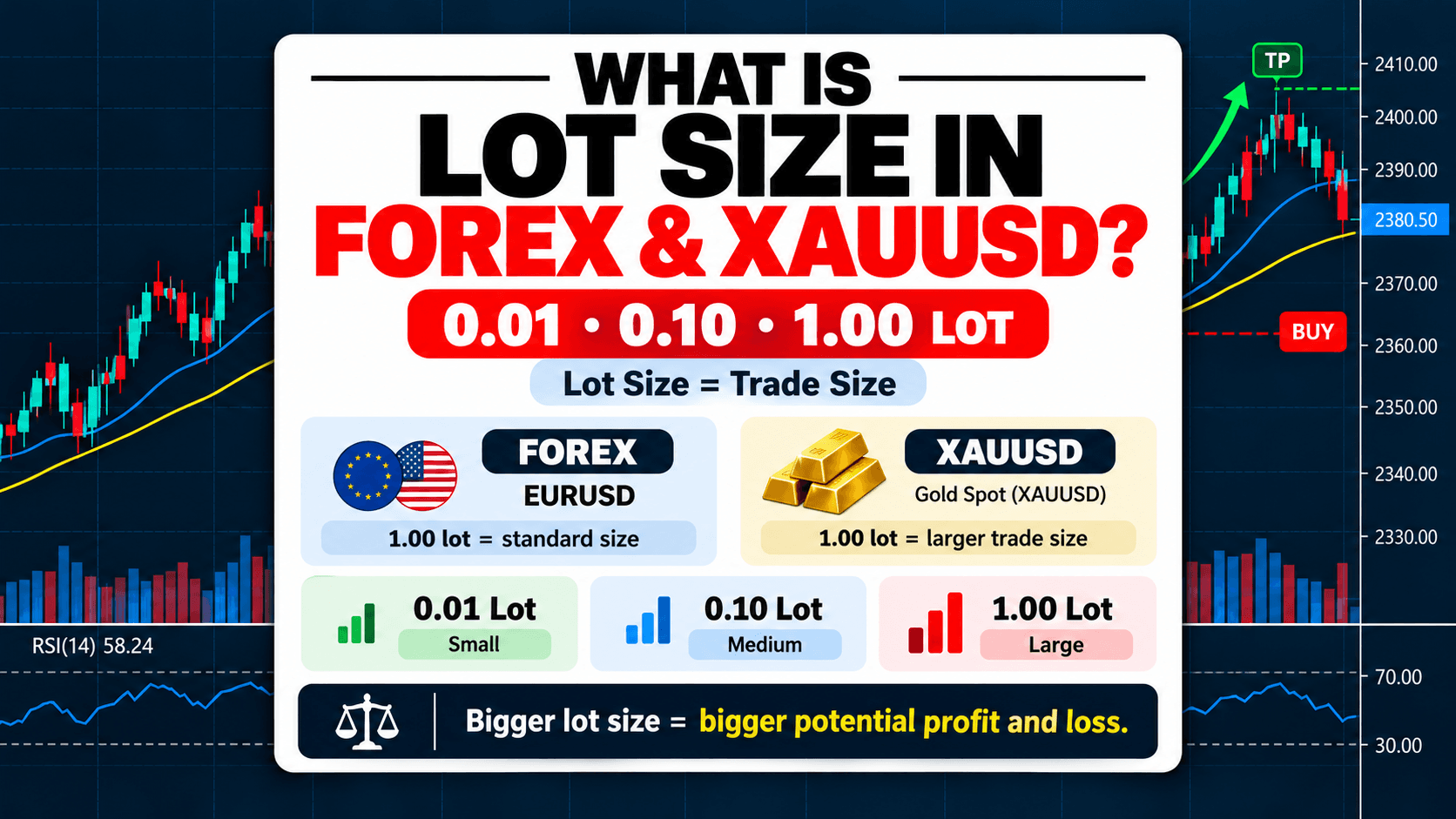
1. What Is a Lot in Forex and MT5?
Lot = Position Size
In MT5, lot size is usually entered in the Volume field when you open a new order.
Common lot sizes include:
- 0.01 lot
- 0.10 lot
- 1.00 lot
For many major Forex pairs, 1 standard lot is commonly associated with 100,000 units of the base currency. However, XAUUSD works differently because its contract size is based on gold.
For example, if a broker defines:
1 lot of XAUUSD = 100 ounces of gold
then the relationship may look like this:
| Lot Size | Example Gold Exposure |
|---|---|
| 0.01 lot | About 1 oz |
| 0.10 lot | About 10 oz |
| 1.00 lot | About 100 oz |
This is only an example. Always check your broker’s Contract Specification because contract size can vary.
Advertisement · IC
2. What Is 0.01 Lot?
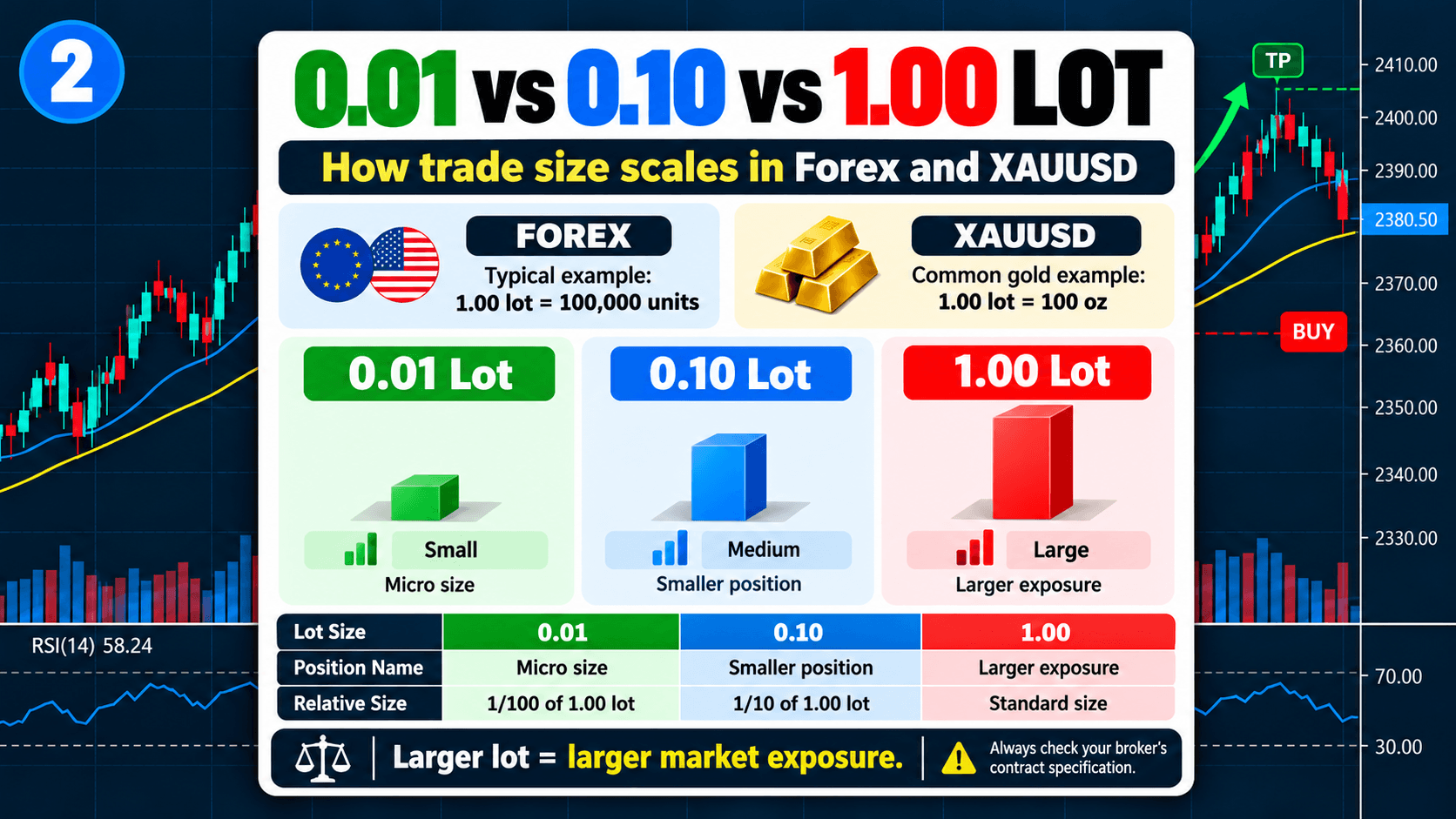
A 0.01 lot position is one-hundredth of a 1.00 lot position.
If 1 lot of XAUUSD equals 100 ounces, then:
0.01 lot ≈ 1 ounce of gold
This is why beginners often use 0.01 lot on a demo account when learning how price movements affect profit and loss.
However, 0.01 lot does not automatically mean “low risk.” Risk also depends on market volatility, account size, stop-loss distance, leverage, and the broker’s contract size.
A better question is not:
“Is 0.01 lot small?”
but:
“How much could I lose if XAUUSD moves against me by $10?”
3. What Is the Difference Between 0.01, 0.1 and 1 Lot?
If the contract specifications are the same, increasing the lot size generally increases the position exposure proportionally.
For example:
0.10 lot is 10 times larger than 0.01 lot.
1.00 lot is 10 times larger than 0.10 lot and 100 times larger than 0.01 lot.
| Lot Size | Relative Position Size |
|---|---|
| 0.01 lot | 1x |
| 0.10 lot | 10x |
| 1.00 lot | 100x |
This means the same market movement can create very different profit or loss depending on the lot size.
A larger lot size does not make a trade more likely to succeed. It simply increases the amount of exposure.
4. How Does Lot Size Affect XAUUSD Profit and Loss?
A simplified way to understand XAUUSD profit and loss is:
Price Change × Contract Size × Lot Size
Assume a broker defines:
1 lot XAUUSD = 100 oz
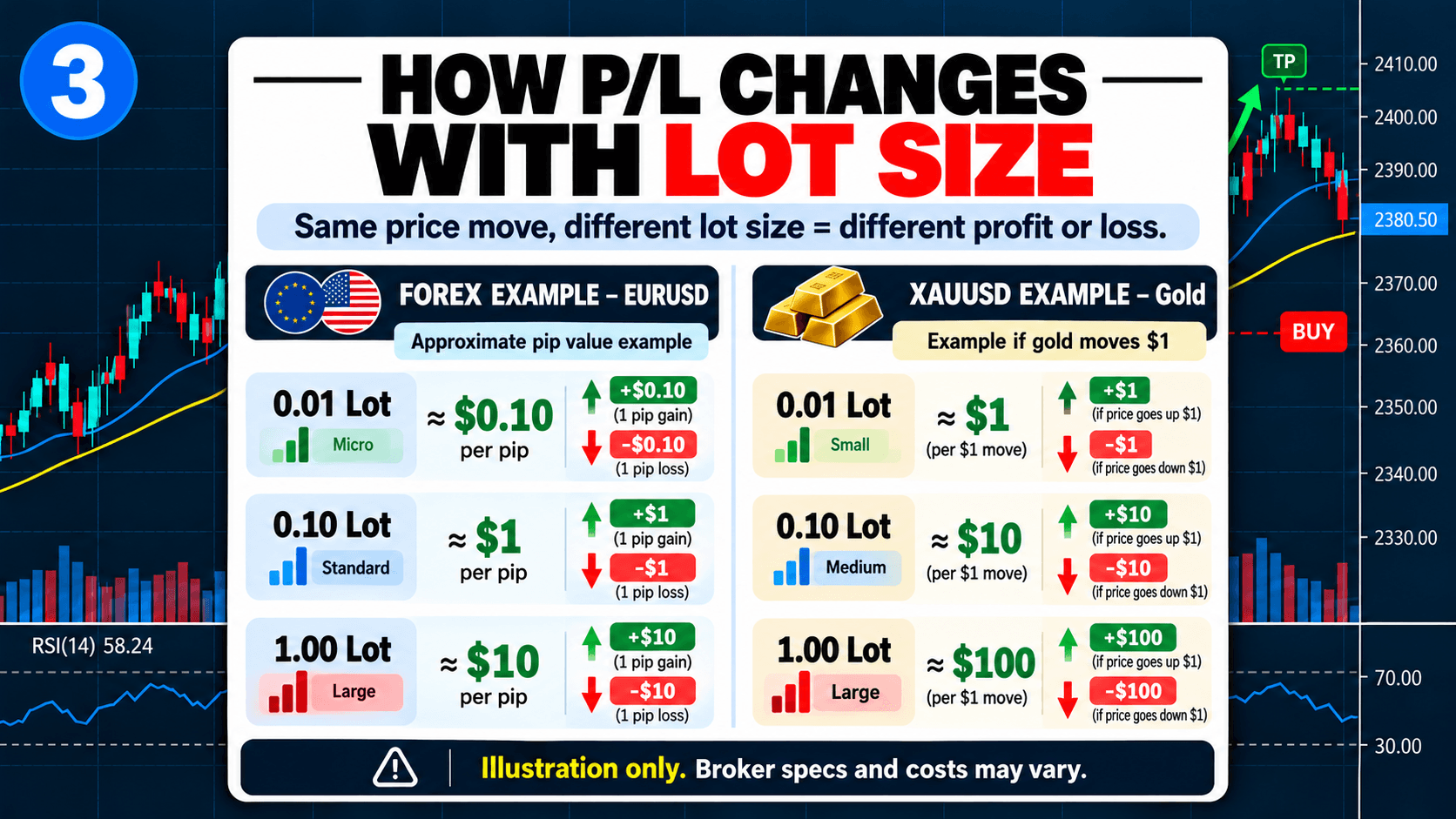
and gold moves from 2385 to 2386, which is a $1 move.
The theoretical impact could be approximately:
| Lot Size | Approximate Impact of a $1 Gold Move |
|---|---|
| 0.01 lot | $1 |
| 0.10 lot | $10 |
| 1.00 lot | $100 |
This simplified example does not include spread, commissions, swaps, slippage, or broker-specific rules.
It is mainly useful for understanding one important relationship:
Larger lot size = larger profit and loss changes for the same price move.
5. What Should You Check Before Choosing a Lot Size?
Before placing an XAUUSD order, open the instrument’s Specification in MT5.
Important fields include:
| Item | What It Means |
|---|---|
| Contract Size | How much of the instrument 1 lot represents |
| Minimum Volume | Smallest lot size available |
| Maximum Volume | Largest allowed position size |
| Volume Step | Minimum increment between lot sizes |
| Tick Size | Smallest price movement |
| Tick Value | Value of each tick |
| Margin | Funds required to support the position |
These numbers are more important than simply memorizing that 0.01 lot is “small” or 1 lot is “large.”
The same lot size can have a different meaning across instruments and brokers.
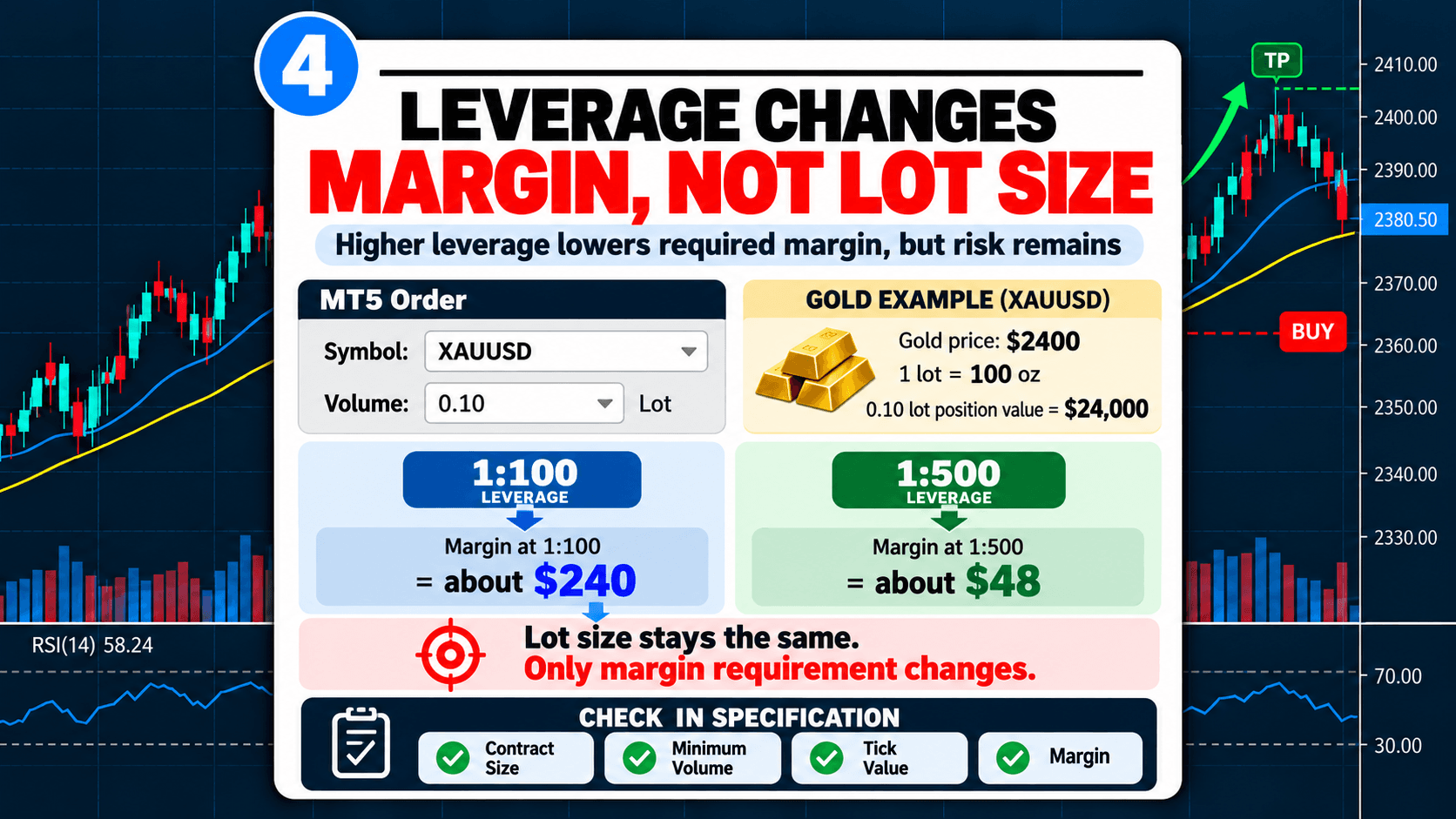
6. Does Leverage Change the Lot Size?
No.
If you open 0.10 lot, it remains 0.10 lot whether the leverage is 1:100 or 1:500.
Leverage mainly affects how much margin is required to open the position.
Higher leverage may reduce the required margin, but it does not automatically reduce the price risk of the position.
So:
Higher leverage ≠ lower trading risk
and:
Lower margin requirement ≠ smaller position
How Should Beginners Practice Lot Size?
If you are learning MT5 for the first time, start with a demo account and observe how different lot sizes react to the same price movement.
For example, compare 0.01 lot and 0.10 lot while watching the same XAUUSD chart. Notice how quickly the floating profit and loss changes, how much margin is used, and how the stop-loss distance affects the possible loss.
The goal is to understand this relationship:
Lot Size → Price Movement → Profit or Loss
before using real funds.
Key Takeaways
Lot size represents the size of your trading position.
For XAUUSD, the exact meaning of 1 lot depends on the broker’s contract specification. In a common example where 1 lot equals 100 ounces of gold, 0.01 lot may represent about 1 ounce, 0.10 lot about 10 ounces, and 1 lot about 100 ounces.
The larger the lot size, the larger the effect of the same price movement on your account.
One-Line Summary
Do not choose an XAUUSD lot size only by looking at 0.01, 0.1, or 1.00—check Contract Size, Tick Value, margin, account balance, and stop-loss distance first.
Next Article: How Is XAUUSD Margin Calculated?
Once you understand lot size, the next step is learning how much margin is required to open a gold position.
The next guide will explain XAUUSD margin calculations, leverage, and why higher leverage does not automatically mean lower risk.
Educational Purpose and Risk Disclosure
This article is for educational purposes only and does not constitute investment advice or a recommendation to buy or sell any financial instrument.
XAUUSD contract size, tick value, minimum volume, leverage, margin requirements, spreads, and trading conditions can vary by broker and account type. Always check the relevant Contract Specification before trading. Leveraged products can result in significant losses.